Monday, October 11, 2010

Dogs in Manteca

“You think dogs will not be in heaven? I tell you, they will be there long before any of us.”

(Robert Louis Stevenson, Scottish essayist, poet and author of fiction and travel books, 1850-1894)
- - - - -

A citizen recently asked my "stance" on the subject of dogs and animal control in Manteca.
I am a registered Manteca voter who is deciding who should be on our City Council. Would you please answer a few questions for me:

1. What is your stance on the condition of the Manteca Animal Shelter?

2. What is your stance on Pit Bulls within our city limits?

3. What are you planning to do to help the animal shelter with the enormous amount of stray animals that they receive?

Thank you for your prompt response
[ ___ ]
A Registered Manteca Voter

This is my response in blue, with additional comment in red:
Dear [Registered Voter],

First, a new animal shelter design and funding plan has just been approved as part of the new city corporation yard on Main and Wetmore Streets. [This was a long-delayed action by the current and previous councils during the "boom" years. Except for the apparent vote-buying by this council, this city facility upgrade is a case of better late than never.]

Second, I have no problem with pit bull breeds, or any other dogs, in the city or anywhere, as long as the owners strictly control them and follow all city animal laws. Dogs only become problems when the owners make them so. [Dogs are not criminals; irresponsible and law-breaking owners are. Besides their inherent natures, animals do what their owners teach them or allow them to do. The Manteca Municipal Code and the Animal Control Department are as much a "policing" fuction of the city as is the Police Department.]

Third, most "stray" animals are not strays but feral, or dumped or abandoned by brainless people. There is only a finite capacity for adoptions out as owners become "saturated" with pets. Even shipping them out to other facilities has a saturation point. After the point of saturation, the only option is euthanasia, horrific as that sounds. They should be pets and have their rights as animals, but they are not people with human rights. [People should be stewards of the earth, its resources, and its life. Husbandry techniques for livestock and pets has been around for how many centuries? Unfortunately, many uneducated or uncaring people foster the problem of animal overpopulation, which puts conscientious people in the unsavory position of cleaning up after them. Even so, I am flat out opposed to animal rights activists who constantly push for granting human rights to non-human species.]

Thank you very much for taking the time to participate in our form of self-government. I appreciate your questions and hope my answers give you the confidence to make your choice of representative to Manteca’s City Council.

Richard Behling

Tuesday, October 5, 2010

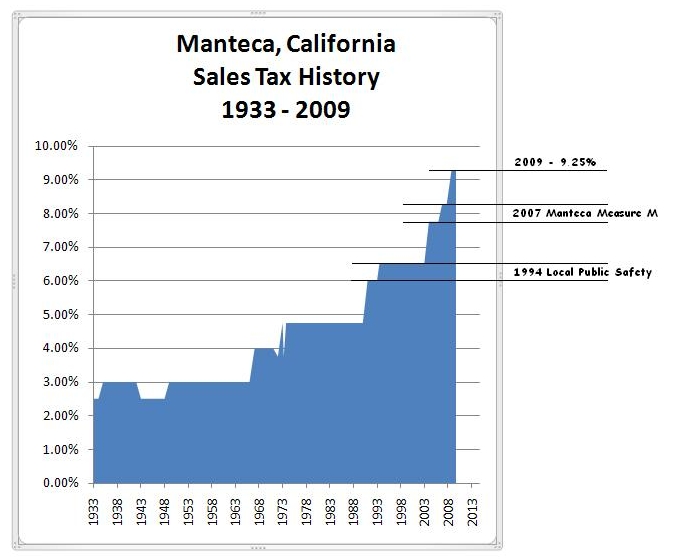
Tough Love & Money: Propositions, Sales Tax, and Measure M(orphine)


The sales tax history of the State of California, and the City of Manteca in particular, tells part of a sad, sad story.
In 1978, California voters staged what has been described as a property tax revolt by approving a statewide ballot initiative known as Proposition 13.

Proposition 13 followed many years of rapidly rising real property taxes in California. From fiscal years 1967-1968 to 1971-1972, revenues from these taxes increased on an average of 11.5% per year. See Report of the Senate Commission on Property Tax Equity and Revenue to the California State Senate 23 (1991) (Senate Commission Report). In response, the California Legislature enacted several property tax relief measures, including a cap on tax rates in 1972. Id., at 23-24. The boom in the State's real estate market persevered, however, and the median price of an existing home doubled from $31,530 in 1973 to $62,430 in 1977. As a result, tax levies continued to rise because of sharply increasing assessment values. Id., at 23. Some homeowners saw their tax bills double or triple during this period, well outpacing any growth in their income and ability to pay. Id., at 25. See also Oakland, Proposition 13—Genesis and Consequences, 32 Nat. Tax J. 387, 392 (Supp. June 1979).


By 1978, property tax relief had emerged as a major political issue in California. In only one month's time, tax relief advocates collected over 1.2 million signatures to qualify Proposition 13 for the June 1978 ballot. See Lefcoe & Allison, The Legal Aspects of Proposition 13: The Amador Valley Case, 53 S. Cal. L. Rev. 173, 174 (1978). On election day, Proposition 13 received a favorable vote of 64.8% and carried 55 of the State's 58 counties. California Secretary of State, Statement of Vote and Supplement, Primary Election, June 6, 1978, p. 39. California thus had a novel constitutional amendment that led to a property tax cut of approximately $7 billion in the first year. Senate Commission Report 28.
(Ref: U.S. Supreme Court opinion, NORDLINGER v. HAHN, 505 U.S. 1 (1992)*)
When property owners passed Proposition 13 in 1978, the State of California, the counties, the cities, and the school districts all experienced a huge and immediate decline in revenues - and faced a future without the windfalls of the past. They were used to the "fat" and must now make do with the "lean."

Municipalities started diverting the skinnier local property taxes into project-restricted Redevelopment Agencies (RDAs) to keep it from going to Sacramento. School districts cried "Foul" and another proposition was passed to lock in a fixed percentage of the state general fund allocated to education. A system of pass-throughs was implemented to equalize the distribution of money and other sources of revenue became a government survival imperative.

One of those sources was ad valorum sales tax - raise the rates and keep raising them. Leading up to 1994, things got so bad where the people live that the state added a half-cent increment to the sales tax collections, earmarked for Local Law Enforcement (Counties and Cities).

The City of Manteca decided, leading up to 2007, just before another real estate bubble burst and recession ensued, that another half-cent sales tax was the ticket. They were using sales tax breaks as chips in a bidding war against nearby cities to woo big retail business into the new but empty shopping centers lining Hwy 120. The trouble is that they were already "locked in" to some long term and overly generous labor contracts, especially those of the public safety service unions. To both play (shoveling tax breaks out the back door) AND pay (front door revenues to sustain high local law enforcement costs), Measure M(orphine) was just the injection needed to sustain the frenetic activity. The voters were convinced to supply the drug.

However, the problems with morphine are: it is addictive; it only treats the pain, not the condition; and, it does not heal terminal patients. An overdose may just kill the patient outright - or incite the geese that lay the golden eggs to vigorously attack the profligate patient!

Voters are now being bombarded with, "Wait! Can't we just trade - or add - marijuana and morphine? Couldn't that solve our revenue problems?" See Proposition 19 - Legalizes Marijuana in California. Why not add another "sin tax?" Why not condone drug use while chasing the almighty $$$ ? Vote NO.

Thrusts, feints, strikes and parries, counter-strikes and hosts of other maneuvers continue to this day over the raising and distribution of various taxes, fees, and other euphemisms for the citizens' money. See Proposition 22 - Prohibits the State from Borrowing or Taking Funds Used for Transportation, Redevelopment, or Local Government Projects and Services. Initiative Constitutional Amendment. (And everybody thinks water politics is bad in California? Money politics is worse!)

Tough Love

The solution is to pare the government back to where it performs only the duties delegated to it by the sovereigns - the citizens. All other programs, transfers, activities, etc. need to be jettisoned or truly transitioned back to private interests. "Privatize" is merely a code-word for government out-sourcing, where the money is collected or paid by government out to a private firm - the money still goes through the government's books. Except for specifically delegated and essential services, do not let government touch the money! Every time it does, the money or service comes back to you in a diminished fashion and constitutes an interference in the economy.

When this approach to limited, efficient government is made to work, the repeal of Measure M(orphine) could be achieved.

- - - - - - - - - - - - - - -
* Court humor: In the Supreme Court opinion referred to, above, Justice Blackmun used these words to sum up the position of protecting current homeowners from upward spiraling property taxes versus those who newly buy a home with the higher assessment values and, thus, higher beginning propertry taxes:

In short, the State may decide that it is worse to have owned and lost, than never to have owned at all.
It is a humorous, but true, adaptation of Alfred Lord Tennyson's poem In Memoriam:27, 1850:

I hold it true, whate'er befall;
I feel it, when I sorrow most;
'Tis better to have loved and lost
Than never to have loved at all.

Monday, September 13, 2010

Setting the Groundwork - Position on Abortion Public Funding


Richard W Behling
Position statement regarding abortions and the use of public funds
September 13, 2010

I am a lifelong member of The Church of Jesus Christ of Latter-Day Saints (LDS) and subscribe fully to the position of God and His prophets on the sanctity of life. Regarding abortions:

“Our members are taught that, subject only to some very rare exceptions, they must not submit to, perform, encourage, pay for, or arrange for an abortion.”

“Our leaders have taught that the only possible exceptions are when the pregnancy resulted from rape or incest, or when a competent physician has determined that the life or health of the mother is in serious jeopardy or that the fetus has severe defects that will not allow the baby to survive beyond birth. But even these exceptions do not justify abortion automatically.” *

On demand abortion is mankind's pathetic attempt to avoid the consequences of wrong reproductive choices. Regarding this most physically obvious of personal morality issues, that most unfortunate of U.S. Supreme Court decisions, Roe v. Wade, 410 U.S. 113 (1973), created a legacy of cascading social error, wholesale destruction of human life, and incalculable moral harm to those who choose the "easy" way out. Beyond the morals arguments, there is no social justification for this practice. Not one cent of public funds should support the abortion practitioners, advocates, and industries that sprang up, or were legalized, in the wake of Roe v. Wade.

I would personally be overjoyed to see this pillar of evil demolished in my lifetime. Whether it is or not, millions of this generation will answer to their would-have-been children and to God, much higher powers than selfish indulgence and the erring SCOTUS.

There may not be much call to action in city council decisions, but my moral foundation stones of sanctity of life and accountability for one’s actions in life are set solidly.

- - - - -
* Dallin H. Oaks, “Weightier Matters,” Liahona, Mar 2000, 15. From a devotional address given at Brigham Young University on 9 February 1999.

Wednesday, August 25, 2010

A Great Summation of Politics (Business and Government)

.


"The free market is simply not capable of screwing up the entire economy without the devoted and unethical assistance from unrestrained and malignant politicians colluding with unethical and malignant businessmen, both of whom are insulated (for a while, at least) from the rule of law and from reality."

Wednesday, August 18, 2010
BETWEEN BRAINS
http://drsanity.blogspot.com/


This is certainly true for the national economy, when the federal lawmakers (oh, how I hate that word), those prostituted puppets, get to mucking around where they have no business mucking.

And a more focused look at California's self-strangulation from The City Journal. (hat tip, Manteca's City Managers Blog, August 14, 2010, "Some Issues Bear Repeating.")

As far as Manteca politics go, the collusion begins almost immediately upon qualifying as a candidate. Thus far, I've had solicitations from two "associations" representing individual professionals and small contractors to come and "interview" in return for (possible) contributions to my political campaign for city councilman. Their public posture is: "We can influence the votes of a block of influencial people on your behalf." The not-so-public deal is: "If we think you will protect and enhance our money-making ability, we'll give you $100 and expect you to vote in our favor on certain questions."

Gee, here I thought that a representative owed a duty, freely given, to individual citizens - not associations, unions, other big enterprises, less-than-general segments of private or public sectors, etc. - those entities other than citizens being known collectively as special interests.

Perhaps these two associations' political marketing dollars should be spent on the public, the voters, to influence their selection of officials, not on the officials to influence their fiduciary votes on the public's business (and maybe against the public's interests.) These associations are perfectly free to make such independent expenditures, as reaffirmed in the January 2010 Supreme Court decision, Citizens United v. Federal Elections Commission.

"In this case we are asked to reconsider Austin and, in effect, McConnell. It has been noted that "Austin was a significant departure from ancient First Amendment principles," Federal Election Comm'n v. Wisconsin Right to Life, Inc., 551 U.S. 449, 490, 127 S.Ct. 2652, 168 L.Ed.2d 329 (2007) (WRTL) (SCALIA, J., concurring in part and concurring in judgment). We agree with that conclusion and hold that stare decisis does not compel the continued acceptance of Austin. The Government may regulate corporate political speech through disclaimer and disclosure requirements, but it may not suppress that speech altogether. We turn to the case now before us."
Perhaps these two associations should sponsor a public forum for ALL candidates to publically announce their views on whatever questionnes du jour these associations wish. You know, ...above board ...out in the open ...encourage public discussion of any issues.

Tuesday, August 10, 2010

Code Enforcement for Construction, Land Use and Civil Behavior


'sic utere tuo ut alienum non laedas'
[so use your own as not to injure another's property]


Manteca Municipal Codes are minimum standards of construction, land uses, and civil individual behaviors. Everyone is free to observe these laws even more strictly than just the bare minimum. Live your life giving offense to no one, and expect the same from your neighbors.

My views reflect my deep belief that property means nothing. A person enters life with nothing and exits the same way, taking only experience (which most often produces knowledge) and relationships - but not property. In the USA, some people acquire and control lots of property (wealth), others none, while most people are the stewards of enough property to sustain their temporary lives... then it is left behind.

- - - - - - - - - - - - - - - - - - - - - -
An interview by the Manteca Bulletin:

Behling vows to focus on ‘inner workings’ of city government
by Dennis Wyatt
July 19, 2010
http://www.mantecabulletin.com/news/article/16003/


- - - - - - - - - - - - - - - - - - - - - -

Zoning ordinances are constitutionally upheld as part of California state government's "police powers" in Miller v. Board of Public Works:

Supreme Court of California
195 Cal. 477; 234 P. 381; 1925 Cal. LEXIS 386; 38 A.L.R. 1479


GEORGE LEE MILLER et al., Appellants, v. BOARD OF PUBLIC WORKS OF THE CITY OF LOS ANGELES et al., Respondents

February 27, 1925

[Regarding] those [regulations] which prescribe the use to which buildings within certain designated districts may be put.

It is conceded, as indeed it must be, by the opponents of the ordinance in controversy here that it is within the police power, by zoning, to banish nuisances and "near-nuisances" from certain districts.

...the court... has held that certain business establishments, harmless in themselves, may become "near-nuisances" because of the character of the neighborhood in which they are operating. ... [A]ny zoning regulation is a valid exercise of the police power which is necessary to subserve the ends for which the police power exists, namely, the promotion of the public health, safety, morals, and general welfare. It will thus be seen that the police power as evidenced in zoning ordinances has a much wider scope than the mere suppression of the offensive uses of property, and that it acts not only negatively but constructively and affirmatively for the promotion of the public welfare.

...

Much is said about the constitutional guaranties attaching to the ownership of property in the individual. In this behalf it will be noted that:

(11) "It is thoroughly established in this country that the rights preserved to the individual by these constitutional provisions are held in subordination to the rights of society. Although one owns property, he may not do with it as he pleases any more than he may act in accordance with his personal desires. As the interest of society justifies restraints upon individual conduct, so, also, does it justify restraints upon the use to which property may be devoted. It was not intended by these constitutional provisions to so far protect the individual in the use of his property as to enable him to use it to the detriment of society. By thus protecting individual rights, society did not part with the power to protect itself or to promote its general well-being. Where the interest of the individual conflicts with the interest of society, such individual interest is subordinated to the general welfare.

- - - - - - - - - - - - - - - - - -


The next year (1926), the decision regarding Miller v. Board of Public Works was cited in Euclid v. Ambler:
U.S. Supreme Court

VILLAGE OF EUCLID, OHIO v. AMBLER REALTY CO., 272 U.S. 365 (1926)

Reargued Oct. 12, 1926.
Decided Nov. 22, 1926.
 
Building zone laws are of modern origin. They began in this country about 25 years ago. Until recent years, urban life was comparatively simple; but, with the great increase and concentration of population, problems have developed, and constantly are developing, which require, and will continue to require, additional restrictions in respect of the use and occupation of private lands in [272 U.S. 365, 387] urban communities. Regulations, the wisdom, necessity, and validity of which, as applied to existing conditions, are so apparent that they are now uniformly sustained, a century ago, or even half a century ago, probably would have been rejected as arbitrary and oppressive. Such regulations are sustained, under the complex conditions of our day, for reasons analogous to those which justify traffic regulations, which, before the advent of automobiles and rapid transit street railways, would have been condemned as fatally arbitrary and unreasonable. And in this there is no inconsistency, for, while the meaning of constitutional guaranties never varies, the scope of their application must expand or contract to meet the new and different conditions which are constantly coming within the field of their operation. In a changing world it is impossible that it should be otherwise. But although a degree of elasticity is thus imparted, not to the meaning, but to the application of constitutional principles, statutes and ordinances, which, after giving due weight to the new conditions, are found clearly not to conform to the Constitution, of course, must fall.

The ordinance now under review, and all similar laws and regulations, must find their justification in some aspect of the police power, asserted for the public welfare. The line which in this field separates the legitimate from the illegitimate assumption of power is not capable of precise delimitation. It varies with circumstances and conditions. A regulatory zoning ordinance, which would be clearly valid as applied to the great cities, might be clearly invalid as applied to rural communities. In solving doubts, the maxim 'sic utere tuo ut alienum non laedas,' [so use your own as not to injure another's property] which lies at the foundation of so much of the common law of nuisances, ordinarily will furnish a fairly helpful clew. And the law of nuisances, likewise, may be consulted, not for the purpose of controlling, but for the helpful aid of its analogies in the process of ascertaining [272 U.S. 365, 388] the scope of, the power. Thus the question whether the power exists to forbid the erection of a building of a particular kind or for a particular use, like the question whether a particular thing is a nuisance, is to be determined, not by an abstract consideration of the building or of the thing considered apart, but by considering it in connection with the circumstances and the locality. Sturgis v. Bridgeman, L. R. 11 Ch. 852, 865. A nuisance may be merely a right thing in the wrong place, like a pig in the parlor instead of the barnyard. If the validity of the legislative classification for zoning purposes be fairly debatable, the legislative judgment must be allowed to control. Radice v. New York, 264 U.S. 292, 294 , 44 S. Ct. 325.

- - - - - - - - - - - - - - -


Camara v. Municipal Court is a San Francisco case that rose to the Supreme Court regarding code enforcement's "police power" to inspect private property to ensure compliance with local codes:

Supreme Court of United States.
387 U.S. 523 (1967)

CAMARA v. MUNICIPAL COURT OF THE CITY AND COUNTY OF SAN FRANCISCO.

Argued February 15, 1967.
Decided June 5, 1967.

The warrant procedure is designed to guarantee that a decision to search private property is justified by a reasonable governmental interest. But reasonableness is still the ultimate standard. If a valid public interest justifies the intrusion contemplated, then there is probable cause to issue a suitably restricted search warrant. Cf. Oklahoma Press Pub. Co. v. Walling, 327 U. S. 186. Such an approach neither endangers time-honored doctrines applicable to criminal investigations nor makes a nullity of the probable cause requirement in this area. It merely gives full recognition to the competing public and private interests here at stake and, in so doing, best fulfills the historic purpose behind the constitutional right to be free from unreasonable government invasions of privacy. See Eaton v. Price, 364 U. S., at 273-274 (opinion of MR. JUSTICE BRENNAN).

Since our holding emphasizes the controlling standard of reasonableness, nothing we say today is intended to foreclose prompt inspections, even without a warrant, that the law has traditionally upheld in emergency situations. See North American Cold Storage Co. v. City of Chicago, 211 U. S. 306 (seizure of unwholesome food); Jacobson v. Massachusetts, 197 U. S. 11 (compulsory smallpox vaccination); Compagnie Francaise v. Board of Health, 186 U. S. 380 (health quarantine); Kroplin v. Truax, 119 Ohio St. 610, 165 N. E. 498 (summary destruction of tubercular cattle). On the other hand, in the case of most routine area inspections, there is no compelling urgency to inspect at a particular time or on a particular day. Moreover, most citizens allow inspections of their property without a warrant. Thus, as a practical matter and in light of the Fourth Amendment's requirement that a warrant specify the property to be searched, it seems likely that warrants should normally be sought only after entry is refused unless there has been a citizen complaint or there is other satisfactory reason for securing immediate entry. Similarly, the requirement of a warrant procedure does not suggest any change in what seems to be the prevailing local policy, in most situations, of authorizing entry, but not entry by force, to inspect.

- - - - - - - - - - - - - - - -

When everyone does no crime and follows MINIMUM standards of behavior, everyone enjoys the benefits of public peace, health, safety, morals and general welfare. Surely, these are things that Manteca residents want. What to do when a selfish neighbor refuses to conform? Call Code Enforcement.


.

Thursday, August 5, 2010

Nomination Form, Statement of Candidate Filed

.

My nomination form, signed by thirty registered Manteca voters, is now filed with the City of Manteca Elections Officer (the City Clerk). Once the signatures and other paperwork are verified, I'll be an official candidate for a Manteca City Council seat in the November 2010 General Municipal Election.

The optional Statement of Candidate Qualifications is also filed and paid for. This statement will be printed in the County's Sample Ballot pamphlet, which is mailed to every registered voter before the election.


STATEMENT OF CANDIDATE FOR
MANTECA CITY COUNCIL


RICHARD BEHLING
Age: 57
Occupation: Accountant

My education and qualifications are: I have worked for a wholesale grocery distributor in this area for 20 years, making my home in Manteca the last 3½ years. I hold a CPA license, a B.S. in Accounting from Utah State University, and an M.S. in Business Administration from CSU, Sacramento. After becoming a resident, I received an alternative education in Manteca politics and operations. Improvements are mandatory. My cycling activity provides another grounded perspective on city needs.

Despite the last explosive growth cycle and fabulous returns to special interests, broad swaths of the existing city have been allowed to deteriorate and many civic amenities have been ignored as the population grew. I will see that the latter projects are given priority. Strong and effective city code enforcement will make policing easier and safer. Especially needed are putting police and fire protection on solid footing, making desperately needed technology upgrades, and giving city managers flexibility in staffing. Roads, water and sewer will be monitored closely. New development will be controlled. My biggest task will be to ensure city finances are managed conservatively, making them and RDA projects open and understandable.

Elect me to get the job done right.

Wednesday, August 4, 2010

Marijuana - Medical or Otherwise

My position is that marijuana remain illegal and unused.


In 1996, the California legislature passed the Compassionate Use Act of 1996. The Act was codified in California's Safety and Health Code, beginning with Section 11362.5. It exempts certain medically indicated and registered users from criminal charges for marijuana cultivation, possession and use, and exempts each user's one legally designated and registered primary caregiver from criminal charges for cultivation and possession, but not use.

The law also allows registered users and caregivers leave to group into cooperatives, for growing and dispensing the drug, but leaves implementation up to local jurisdictions.

Given this particular legal loophole, my position on medical marijuana is that individual users and caregivers take care of their own needs and follow Manteca's ordinance to enclose and secure any "weed." Manteca does not need a dispensary.

If the 2010 California Proposition 19 passes in November, a single city-operated dispensary may be necessary for control and taxation.


I also believe anyone who possesses a medical marijuana user card should be required to surrender his or her Driver License - it's one or the other, not both.

Indeed, from the California Safety and Health Code:
Section 11362.5. (a) This section shall be known and may be cited as the Compassionate Use Act of 1996... (b)(2) Nothing in this section shall be construed to supersede legislation prohibiting persons from engaging in conduct that endangers others...
California's Vehicle Code Section 312 defines a drug as:
The term "drug" means any substance or combination of substances, other than alcohol, which could so affect the nervous system, brain, or muscles of a person as to impair, to an appreciable degree, his ability to drive a vehicle in the manner that an ordinarily prudent and cautious man, in full possession of his faculties, using reasonable care, would drive a similar vehicle under like conditions.
My stance is the marijuana use produces a driving-under-the-influence impairment (DUI) sufficient to bar such user from driving on California's roadways, a stance backed up by research.
How Does Marijuana Affect the Brain?

Scientists have learned a great deal about how THC acts in the brain to produce its many effects. When someone smokes marijuana, THC rapidly passes from the lungs into the bloodstream, which carries the chemical to the brain and other organs throughout the body.
THC acts upon specific sites in the brain, called cannabinoid receptors, kicking off a series of cellular reactions that ultimately lead to the “high” that users experience when they smoke marijuana. Some brain areas have many cannabinoid receptors; others have few or none. The highest density of cannabinoid receptors are found in parts of the brain that influence pleasure, memory, thoughts, concentration, sensory and time perception, and coordinated movement.
Not surprisingly, marijuana intoxication can cause distorted perceptions, impaired coordination, difficulty in thinking and problem solving, and problems with learning and memory. Research has shown that marijuana’s adverse impact on learning and memory can last for days or weeks after the acute effects of the drug wear off. As a result, someone who smokes marijuana every day may be functioning at a suboptimal intellectual level all of the time.
Research on the long-term effects of marijuana abuse indicates some changes in the brain similar to those seen after long-term abuse of other major drugs. For example, cannabinoid withdrawal in chronically exposed animals leads to an increase in the activation of the stress-response system and changes in the activity of nerve cells containing dopamine. Dopamine neurons are involved in the regulation of motivation and reward, and are directly or indirectly affected by all drugs of abuse. (internal references removed)